Показаны сообщения с ярлыком 1700 Campaign (Riga). Показать все сообщения

среда, 21 ноября 2018 г.

Lithuanian troops to be raised for the siege of Riga, 1700

On 3 July of 1700 king August II & Lithuanian Grand Hetman Kazimierz Jan Sapieha signed an agreement, that Sapieha agreed to raise & provide on the royal service for the siege of Riga 3.660 Lithuania troops in exchange of 30.000 Thalers.
List of troops:
Husaria (4 choragwies, 600 koni): Kazimierz Jan Sapieha, Hetman wielki litewski (150), Józef Bogusław Słuszka, Hetman polny litewski (150), Benedykt Paweł Sapieha, podskarbi wielki litewski (150), Dominik Michał Słuszka, wojewoda połocki (150)

воскресенье, 6 марта 2016 г.

Two Saxon memorial medals dedicated to the campaign of 1700


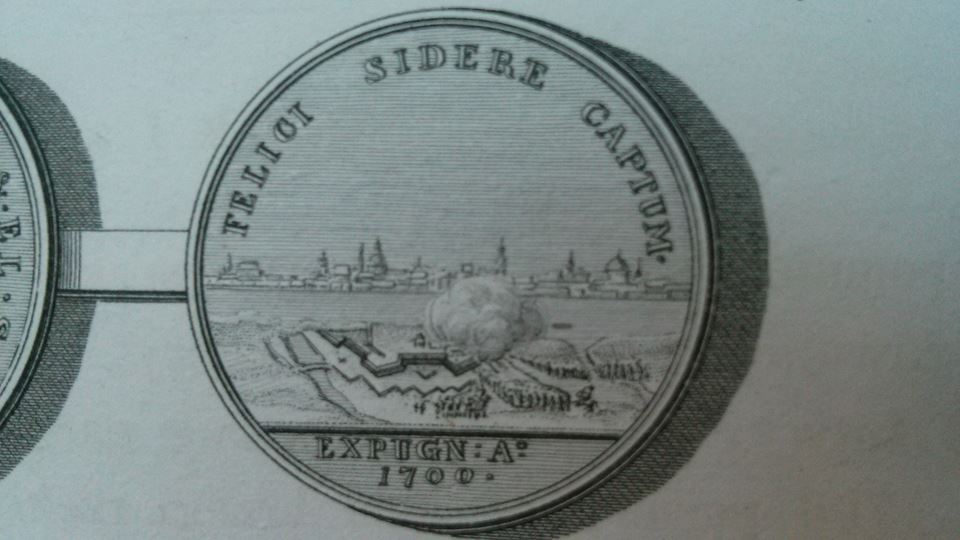
Polish-Saxon memorial medal of taking Cobron
Grzegorz Szymborski found two interesting Polish-Saxon memorial medals related to the campaign of 1700. One is dedicated to the taking of Kobron fort by Saxon forces on 25 Feb. 1700. The entrenchment was situated on the right bank of Dune river opposing Riga. It was was held by a small Swedish garrison of 50 men under captain Bildstein & easily capitulated to outnumbered Saxon forces after 2-days defense. The second medal is dedicated to the taking of Dunamunde on 23 March 1700, see details here (link)
Polish-Saxon memorial medal of taking Dunamunde
The source is: 

понедельник, 11 января 2016 г.

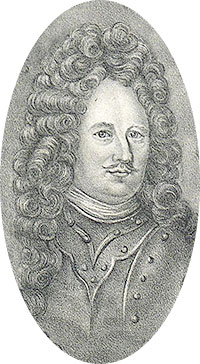
Vellingk, Otto

Otto Velling
a portrait by unknown artist
unknown collection in Karlberg
Otto Vellingk (or Welling; 1649-1708) was one of the leading Swedish commanders at the beginning of the Great Northern war. But his profound portrait is hard to find. His well-known image (available on Wiki & other web-sources, link) was done in 1840s for Mellin's work about 427 most famous Swedes (Mellin G.H. 427 portratter af namnkunniga svenske man och fruntimmer. 1847, link). I also found a b/w photo of Velling's portrait from unknown collection in Kalberg (link). Evidently it was the source for the later engraving.
Right now the portrait is in Karlberg Castle (Swedish Military Academy). I'll be pleased for its image in a good quality.
Velling's service according to Lewenhaupt's Karl XII's officerre was the following:
- 1664 entered military service as a Lojtnant of a Swedish regiment in Bremen
- 1666 a Ryttmeister of Konigsmark cavalry regiment on French service
- 1668 a Major of the same regiment
- 1670, in one source I found that he became a colonel on French service
- 20/8 1676 received a pattern to raise an enlisted cavalry regiment on Swedish service
- Dec. 1676 distinguished in the battle of Lund, became a Friherre on 23/12
- 1678 Overste of Nylands och Tavastehus Rytters

среда, 18 ноября 2015 г.

Saxon army at the outbreak of the Great Northern war, spring 1700

Many know outstanding Notes on Saxon army 1700-1716 by Dan Schorr (it was placed on his northernwars.com site, now it's closed). The text below is updated & expanded version.

General-Staab
Chief in command: GFM Adam Heinrich v. Steinau
Kriegs-Commisariat, ab. 40 men, Kriegs-Commissar G-de-I Karl Gustaf v. Lewenhaupt
Inspekteur-General Major General Lange
Quartiermeister-General Major General Ludwig v. Hallart
Proviant Amt, 156 men
Equipage Amt, 80 men
Feld Lazareth, 10 men
Kadet Compagnie, 188 men, incl. 120 Cadetts & 9 teachers
Kurfurstische Garde
Leibtrabantengarde, 12 coys of 54 men (incl. 35 trabants). Since 1/05/1700 each company expanded to 50 trabants. On 18/05/1700 the troop renamed to Garde zu Pferde or Garde du Corps. Its new commander became Leutnant General Carl Gustav Jordan.
Grand-Mousquetaires, 3 coys of 60 men, G-de-I Karl Gustaf v. Lewenhaupt

понедельник, 26 мая 2014 г.

Siege & taking of Kokenhausen, 29 Sept. - 4 Oct 1700

Plan der Festung Kokenhausen, belagert und erobert durch die sächsische Armee, 29. September - 4. Oktober 1700
(Hessichen Staatsarchiv Marburg)
I have written some about the Saxon campaign of 1700 against Riga (link). August the Strong raised the siege of Riga on 19 September (NS) . His reasons were a lack of artillery supplies to continue the bombardment & news that Carl XII was going to disembark in Baltic provinces. Saxons decided to take Kokenhausen (Kokenhusen. modern Koknese), which laid on the right bank of Dune river in about 65-70 km to S-E from Riga, & made there their base for the next campaign of 1701.
Saxon bombardment of Kokenhausen
(engraving from Faber's work, ab. 1701)  
Kokenhausen was an old Teutonic castle with weak fortifications. It's garrison under major Henrik Haij was about 270-300 men: 50 from Osterbotten infantry regiment (1 officer, 3 NCOs, 46 privates), 77 from Dahlberg's, 80 from Soop's plus some artillery personnel & cavalry.
Kokenhausen fortifications around 1700
(Swedish Riksarkivet)
Saxons under Field-Marshal Adam Heinrich Steinau approached Kokenhausen on 29 Sept 1700 (NS). Swedes estimated their strength of 5,000 of infantry & 7,000 of cavalry. Evidently it was the whole army, which retreated from Riga. Steinau suggested Swedes to surrender but they refused. Saxon opened siege works. They built 3 batteries, one of 11 cannons, one of 9 & one of 4 mortars. Saxons started the bombardment on 3 of October, & on the next day the garrison agreed to capitulate on the terms of free passage. They came to Riga on 6 October. Haij was arrested after his capitulation & died in mid-October.
Saxons left at Kokenhausen a strong garrison & retreated to Courland on winter quarters. Their campaign of 1700 was finished. 

Осада и взятие Кокенхаузена, 29 сентября - 4 октября 1700.

View of Kokenhausen from N-W by J. Brotce
Ранее я уже несколько раз писал о летней кампании 1700 саксонцев на Двине и их неудачной осаде Риги (ссылка). Начав бомбардировку крепости 6 сентября (Н.С.), они уже18 приняли решение о снятии осады и отходе от Риги. Причин было две: недостаток боеприпасов для продолжения бомбардировки и осады, и полученные известия о том, что Карл XII готовится к переброске своих войск в Прибалтику. Перед окончательным отходом на зимние квартиры на левый берег Двины, саксонцы решили взять Кокенхаузен, находившийся примерно в 65-70 км от Риги. Этот старый тевтонский замок они планировали использовать как базу для своих операций в следующем 1701 г.

понедельник, 31 марта 2014 г.

Saxon siege artillery, captured at Dunamunde on Dec 1701

Two Saxon 24-pdr cannons, captured at Dunamunde:
- cast in 1686 (top)
- cast in 1653 (bottom)
(Drawing by J. Thelott, Armemuseum, Stockholm)
Saxons opened operations against Riga in February of 1700 (see more), but they brought the siege artillery to the city only in July of 1700. On 18 July the Polish-Saxon army (see more) crossed Duna river & on the next day it defeated Swedish army under Otto Welling in the battle of Probstingoff or Jungfernhoff (modern Jumprava). The victory allowed Saxons to start siege work & create batteries on the right bank of Duna river. The bombardment started on 27 August. Saxons brought a limited volume of powder & cannon-balls from Saxony, and they were over by 8 of September. It made King August to lift the siege & retreat back on the left bank of the Duna. The siege artillery was put in Dunamunde fortress.
Two Saxon 24-pdr cannons, captured at Dunamunde:
- cast in 1696 (top)
- cast in 1686 (bottom)
(Drawing by J. Thelott, Armemuseum, Stockholm)
In July of 1701 Saxon army was defeated by Karl XII in the battle on Duna river & retreated into Courland. Dunamunde was blocked by Swedish troops. It's garrison consisted of unknown number of Saxons under colonel Kanitz & 4 coys of Russian infantry (ab. 460 men) under lieutenant-colonel Herman (Eremey) Schwart. It capitulated on 21 December 1701 on the terms of free passage. On 28 December the garrison numbered 1074 men, both Saxons & Russians.  
Swedes captured in Dunamunde 79 cannons (incl. 2 ex-Swedish lost in March of 1700) & 18 mortars.
The Saxon cannons (77) were the following: 36 24-pdr, 2 16-pdr, 21 12-pdr, 10 6-pdr, 8 3-pdr.
Saxon mortars (18): 4 196-pdr, 4 96-pdr, 4 64-pdr, 3 32-pdr, 3 16-pdr.
The most of cannons & mortars were casted in 1650-1680s. Their description you can see in the "Specification of the trophies" at the bottom of the post. The engravings of the trophied cannons were done by J. Thelott.

Саксонская осадная артиллерия, захваченная в Дюнамюнде 22 декабря 1701 г.

Saxon cannons, captured at Dunamunde:
- Polish 3-pdr (left)
- 196-pdr mortar 
- Saxon howitzer
(Drawing by J. Thelott, Armemuseum, Stockholm)
Саксонцы начали операции против Риги еще в феврале 1700 (см подробнее), но крепнокалиберную артиллерию для ведения нормальной осады привезли лишь в конце июля 1700 г. Разбив Веллинга 19 июля в сражении при Пробштингофе или Юнгфернхофе (совр. лат. Jumprava), саксонцы подошли к стенам города и начали сооружение батарей. Бомбардировка началась 27 августа, но запасы привезенных из Саксонии пороха и ядер были незначительны, и уже 8 сентября король Август был вынужден снять осаду, и увезти осадную артиллерию на зиму в Дюнамюнде (переименованную в Августбург). Весной 1701 возобновить осаду Риги саксонцам не удалось. В июле они были разбиты в битве на Двине, и отступили вглубь Курляндии. Гарнизон Августбурга под командованием полковника Каница был отрезан и сидел в блокаде до 21 декабря 1701, когда, наконец,
Saxon mortars, captured at Dunamunde:
- 64-pdr
- 32-pdr
(Drawing by J. Thelott, Armemuseum, Stockholm)
капитулировал на правах свободного выхода. Надо отметить, что в июле 1701 в Августбург были направлены 2 роты полка Томаса Юнгора (капитанов Ивана Колтовского и Ивана Мещерского), рота капитна Василия Владычкина из полка Тимофея Трейдена и рота капитана Степана Оленина из полка Дениса Рыддера - всего около 460 чел. под общим командованием подполковника Еремея Шварта из полка Юнгора. На 28 декабря гарнизон насчитывал 1074 чел., сколько из них было русских и подробности их возвращения домой неизвестны, Еремей Шварт указан подполковником одного из солдатских полков главной армии уже в конце 1702 г.
В Дюнамюнде шведы захватили 79 пушек и 18 мортир. Пушки: 36 24-фунтовые, 2 16-фунтовые, 21 12-фунтовая, 10 6-фунтовых, 10 3-фунтовых (вкл. 2 бывшие шведские захваченные весной 1700 г.). Мортиры: 4 196-фунтовые, 4 96-фунтовые, 4 64-фунтовые, 3 32-фунтовые, 3 16-фунтовые.
Большинство из указанных орудий были отлиты в 1650-1680х, но также встречаются и образцы, отлитые в XVI веке. Отлив крупнокалиберных орудий был дорогим и трудоемким делом, и в XVIII в. считалось абсолютно нормальным использовать качественно отлитые орудия, которым по 50-100 лет. Это позволяет по-иному взглянуть на рассхожий термин об "устареших образцах орудий" под нарвой в 1700 г.
Описания всех захваченных пушек приведено в "Спецификации...", а рисунки 20 пушек и 5 мортир приведены в работе Я. Фелотта.  


понедельник, 23 мая 2011 г.

Courland army & colours in 1700-01


Jager zu Pferde kompanie standard, ab. 1700
(averse)
State Trophy Collection, Armemuseum
(Stockholm)

According to the Mariusz Balcerek’s materials, Courland military forces in 1700-01 consisted of 6 mounted & 2 foot coys (see details here http://kurlandia.wordpress.com/2011/03/03/sily-zbrojne/#comments):
- 1 kompania Garde du Corps,
- 2 kompanie Garde Dragoner,
- 2 kompanie Lehnsreiter (from Kurlandia & Semigalia?),
- 1 kompania Jäger zu Pferde,
- 2 foot kompanie.
Some of the cavalry troops took part in the 1700-01 campaigns (allied BO’s include “Duke’s Guards” or “Duke’s Cuirassiers”) while the foot evidently stayed in the garrisons of Mitau & Bausk.
I found 3 Courland colours in the Swedish State Trophy Collection (STC; Digital Museum site):
-        - White infantry colour with red lion
-        - White cavalry standard with gold lion
-       - Green cavalry standard with horn
The green one is attributed by M. Balcerek as Jager zu Pferde

суббота, 26 марта 2011 г.

Saxon attack of Dunamunde on March 11 (12) / 23, 1700

By the mid of February 1700 Saxons concentrated in Courland 3 infantry (1 Garde, Konigin, Bornstadt) & 4 dragoon (Weissenfels, Flemmimg, Sanosth, Wolffenbuttel) regiments under command of GL Flemming. On Feb 11, 1700 they opened hostilities & without declaration of war marched into Swedish Livland. On 14 of February they took fort Kobrun on the left bank of Dune opposite Riga. Further operations against the city were limited because a lack of artillery. Flemming had only 6 3-pdr regimental cannons. On March 11 (12)/23 Saxons decided to attack Dunamunde, a fort on the cape between Dune & the sea. It was defended by a battalion of Nylands infanteriregimente under oversten G.W.v.Budberg (500 men). Saxon forces consisted of the 3 infantry regiments & Weissenfels dragoons under GM Karlowitz. The night attack was repulsed with heavy losses: 248 killed (incl Karlowitz) & 435 wounded (see details in relation below). But in 2 days Budberg agreed to capitulate on the terms of the free passage to Riga. Interesting moment: Schuster & Francke mentioned 143 Saxons killed & 435 wounded.
Saxon attack on Dunamunde, 23 Mar 1700 by Broce

Saxon relation is taken from Sachsen-Anhalt University collection. It was written on 14 (15)/26 of March after Swedish capitulation.    

понедельник, 8 ноября 2010 г.

Swedish forces in Baltic provinces, Sept 1700

The table below is combined from several sources.

Regiment
Coys
Strength
Comments
Riga garrison under FM E. Dahlberg

Abo inf. Reg.
3
400
In Spring 1701 – 376 men

Bjorneborg inf. Reg.
2
250
In Spring 1701 – 224 men

Tavastehus inf. Reg.
2
250
In Spring 1701 – 243 men

Savolaks inf. Reg.
3
350
In Spring 1701 – 313 men

Viborg inf. Reg.
3
250
In Spring 1701 – 328 men

Nyland inf. Reg.
3
400
In Spring 1701 – 364 men

Osterbotten inf. Reg.
8
850
In Spring 1701 – 824 men

8
850


8
750


Livland Adelsfan
4
320


A coy from Finish regiment
1
70


40+5
4 750
Estimated strength
Corps under G-o-C O. Welling at Rujen

Combined Finish IR under G.A. Mellin
8
950
Formed from detached coys of Riga garrison

Abo cav. Reg.
8
900
On 18/29 Nov: 750 men in 7 coys

Nyland Cav. Reg.
8
750


Karelska Cav. Reg.
8
700

четверг, 4 ноября 2010 г.

Saxon & Polish-Lithuanian troops at Riga, summer 1700

My list of Saxon & Polish-Lithuanian troops is based on Schuster & Francke, Wimmer & several BO’s from Marburg archive.
Saxon troops:
Guard units (4): Garde du Corps (4 squadrons), Grand Mousquetaires, Karabiniers and Grenadiers a Cheval
Cuirassier regiments (4): Leib, Flemming, La Forest/Kurprinz, Beust
Dragoon regiments (4): Weissenfels, Flemmimg, Sanosth, Wolffenbuttel
Infantry regiments (8): 1 Garde, 2 Garde, Konigin, Bornstadt, Flemming, Robel, Liesenhausen, Bentendorff
Polish troops (Wimmer, p. 53): foot regiments of Royal Guard (Gwardii Koronnej, gen. Donhhof, ab. 600 men) & Queens (Krolowej, ab. 400 men) & about 1 200 light horses (regular choragwies under hetman polnej koronnej S. Potocki & private magnates choragwies)
Lithuanian troops: their estimated strength was about 3 000. Most of them were pancerni & wallachian choragwies. Some sources mention presence of the Lithuanian infantry & 3 coys (kornet) of dragoons 

Saxon mounted Guard units (Leibgarde zu Ross) in 1700

I would like to say thank you to Dan Schoor for remark he made about Saxon mounted Guard units in my post about Polish-Saxon BO at Riga. He wrote that Schuster & Francke’s data about Saxon Guard units in my post was wrong (now it’s updated). He provided me with a link to Minckwitz’s book (Minckwitz, August von. "Die ersten kursachschen Leibwachen zu Ros und zu Fus und ihre Geschichte". Dresden, 1894).
Ancient Saxon Corps of mounted Leib-guard (Leib-Garde zu Ross) since 1681 also was called Trabanten (Trabanten-Leibgarde zu Ross). The term Garde du Corps was first used in 1697, but other names were also in use. Since January 1, 1677 it consisted of 4 squadrons.
In 1698-99 the fourth squadron of the Trabanten-Leibgarde was converted into 3 new Corps: Grand Mousquetaires, Karabiniers and Grenadiers a Cheval. (s. 50). Evidently each of them was of a company strength.
The fourth squadron was re-established by 1699. On May 1, 1699 the Garde du Corps consisted of 4 squadrons, each of 3 coys or brigades. Squadrons differed each other by a color of horses: white in the 1st (Obristen prince Alexander Sobieski), black in 2nd (Obrist-lieutenant von Bensig), dark-brown in 3rd (Obrist-wachtmeister Senge) & light-brown in 4th (Obrist-wachtmeister von Rothe). Each squadron consisted of: 3 Rittmeister, 3 Lieutenant, 1 Cornet, 1 Quartiermeister, 1 Feldscheer, 3 Wachtmeister, 9 Korporale, 6 Trompeter, 1 Fahnen-Sattler, 1 Fahnen-Schmeid, 135 (increased to 150 on May 1, 1700) Trabantans. Corps staff included 1 Adjutant, 1 Ober-Auditeur, 1 Feldprediger, 1 Pauker, 1 Profos.
In 1700 new corps commander (and a commander of 1st squadron) became General-Lieutenant Carl Gustav Jordan.

In July 1700 the Corps arrived to Riga.

четверг, 28 октября 2010 г.

Polish-Saxon BO at Riga in Livland, 4. August 1700

Marburg archive’s collection has a very interesting Polish-Saxon BO dated 4 August 1700. (http://www.digam.net/?dok=5753). It doesn’t meet with data from Schuster & Franke (Schuster O., Francke F.U. Geschichte der Sächsischen Armee. Leipzig, 1885, Teil 1). My main concerns are about Guard mounted units & converged grenadiers.

Feldlager der Polen gegen die Schweden vor Riga in Livland, 4. August 1700
Commanding officers:
FM Steinau,
second-in-command Duke of Courland
General-lieutenants: Bornstedt, Roebel
General-majors: Bretendorf (=Bentendorf), Venediger, Peust (=Beust)
1st Line
Right wing
- Flemming Dragoons
- Grenadiers a’Cheval 
- Carabinirs
- Garde du Corps
- Regiment du Roy (=Leib Reiterei)